
Nationwide Credit Unions is an independent educational resource designed to help consumers understand how credit unions work, how membership eligibility works, and how credit union banking compares to traditional banks.
Many consumers research credit unions after dealing with high bank fees, loan denials, limited ATM access, or confusing membership requirements. Our guides explain how credit union checking accounts, loans, refinancing, ATM networks, mobile banking apps, digital payment systems, and shared branching networks work so consumers can make more informed financial decisions.
We are not a bank, lender, or financial institution. Instead, Nationwide Credit Unions publishes independent educational content covering credit union membership, banking services, refinancing, ATM access, digital banking tools, online transfers, mobile payments, and financial services used by consumers across the United States.
Quick Answer: What Is a Credit Union?
A credit union is a member-owned financial cooperative that provides banking services such as checking accounts, savings accounts, loans, credit cards, ATM access, and digital banking tools. Unlike traditional banks, credit unions operate as nonprofit institutions focused on serving members rather than outside shareholders.
Many credit unions offer lower fees, competitive loan rates, shared ATM access, mobile banking apps, refinancing programs, and relationship-focused customer service. Some also provide nationwide ATM access and shared branching systems that allow members to access services far beyond their local branch area.
Credit Unions With Nationwide Access
One of the biggest misconceptions about credit unions is that they only operate locally. While many credit unions are community-based or regional institutions, some provide nationwide ATM access, shared branching services, online account management, and mobile banking tools that allow members to bank almost anywhere in the United States.
Many credit unions participate in CO-OP shared ATM networks and shared branching systems, which may provide access to 30,000+ surcharge-free ATMs and 5,000+ shared branch locations nationwide. Availability varies by institution, but these networks can make some credit unions much more accessible than consumers expect.
Examples of large credit unions with broad national recognition or digital access include Navy Federal Credit Union, PenFed Credit Union, and Alliant Credit Union. These institutions differ in membership requirements, loan options, ATM access, and online banking features, so consumers should compare eligibility and account details before joining.
- Top 25 Largest Credit Unions in the United States
- Navy Federal Credit Union Guide
- Find Credit Unions Near You
- Credit Unions Across All 50 States
Consumers often compare nationwide credit union access when looking for lower fees, shared ATM availability, refinancing options, better customer service, or alternatives to large national banks.
Start Here: Popular Credit Union Topics
If you are new to credit unions or comparing them against traditional banks, these guides explain some of the most common questions consumers ask before opening accounts, applying for loans, refinancing debt, or switching financial institutions.
- Credit Union Basics
- How Credit Union Membership Works
- Can Anyone Join a Credit Union?
- How to Open a Credit Union Account
- Credit Union Minimum Deposit Requirements
- Do Credit Unions Check ChexSystems?
- Credit Union Pros and Cons
- Find a Credit Union Near You
These foundational guides explain how membership eligibility works, what makes credit unions different from banks, how minimum deposits work, and what consumers should compare before joining a financial institution.
Credit Union Banking, Checking Accounts & Digital Services
Most modern credit unions now offer digital banking tools similar to traditional banks, including online transfers, mobile deposits, debit cards, digital wallets, ATM access, bill pay tools, and payment apps. However, features, transfer systems, ATM availability, and mobile banking integrations vary between institutions.
- Credit Union Checking Accounts
- Credit Union Savings Accounts
- Credit Union Digital Banking Services
- Payment Apps Credit Unions Support
- How Credit Union Routing Numbers Work
- Credit Union Wire Transfers Explained
Understanding how digital banking systems work can help members avoid transfer delays, compare ATM access, manage mobile payments more effectively, and determine whether a credit union offers the banking tools they need.
Credit Union Loans, Credit Checks & Refinancing
Many consumers compare credit unions against traditional banks when searching for auto loans, refinancing options, student loans, mortgages, credit cards, and lower interest rates. Because credit unions often use relationship-based lending models, approval requirements and loan structures may differ from larger national banks.
- Credit Union Loan Options
- Do Credit Unions Check Credit?
- Credit Score Requirements for Credit Union Loans
- Credit Union Auto Loan Refinance
- Credit Union Student Loans
These lending guides explain how approval works, when credit checks are used, how refinancing programs function, and what borrowers should compare before applying for financing.
ATM Access, Fees & Everyday Banking Costs
Credit unions are often associated with lower fees and member-focused banking, but ATM rules, overdraft policies, transfer fees, and withdrawal limits still vary between institutions. Understanding these differences can help consumers avoid unnecessary banking costs.
- Credit Union ATM Fees
- Credit Union Overdraft Fees
- Credit Union vs Bank Fees
- ATM Withdrawal Limits at Credit Unions vs Banks
Many credit unions also participate in nationwide ATM networks and shared branching systems that allow members to access financial services beyond their local branch locations.
Find Credit Unions by State and Region
If you are searching for local credit unions, regional membership eligibility, nearby ATM access, or statewide financial institutions, our state and regional guides can help you compare institutions across the United States.
- Credit Union Near Me Directory
- Credit Unions Across All 50 States
- Top 25 Largest Credit Unions in the United States
- Browse state examples including Ohio, Texas, California, and Florida.
- Browse by region: Midwest, South, Northeast, and West.
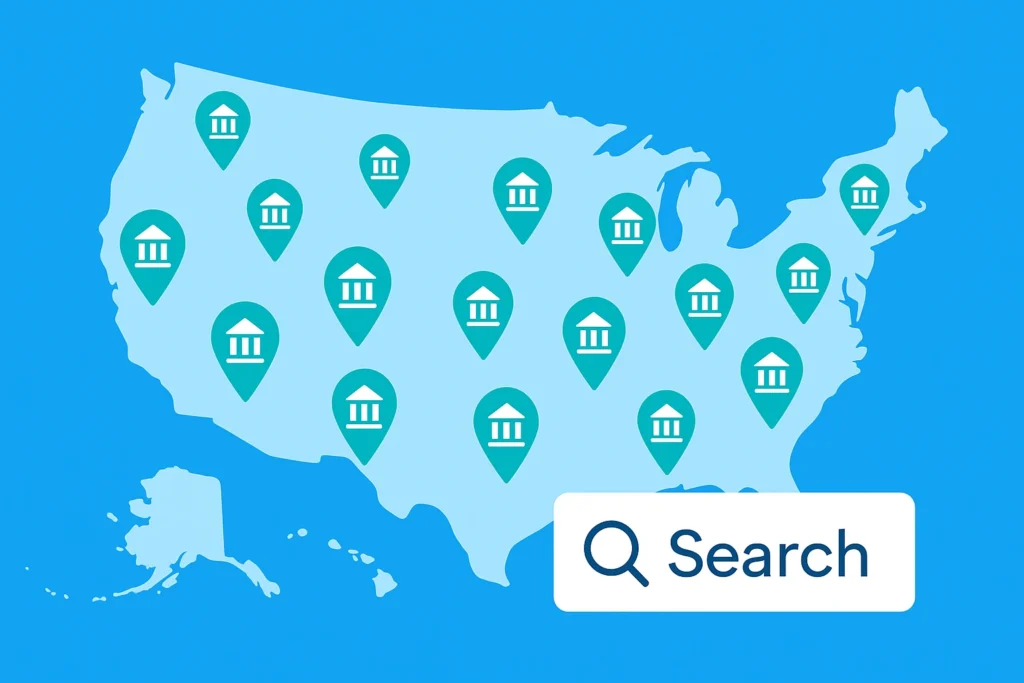
How Credit Unions Compare to Traditional Banks
Credit unions and banks often provide many of the same financial services, including checking accounts, savings accounts, loans, credit cards, ATM access, and digital banking tools. However, the ownership structure, lending approach, fee structure, and customer experience may differ significantly between institutions.
| Feature | Credit Union | Traditional Bank |
|---|---|---|
| Ownership | Member-owned cooperative | Shareholder-owned company |
| Profit Structure | Nonprofit | For-profit |
| Customer Focus | Member-focused | Business-focused |
| ATM Networks | Shared networks often available | Bank-owned networks |
| Loan Decisions | May emphasize relationships | Often centralized underwriting |
| Branch Structure | Usually regional or community-based | Often national or multi-state |
Some consumers prefer credit unions because of lower fees, local service, relationship-focused lending, and shared ATM access, while others prioritize large branch networks or broader banking product ecosystems offered by national banks.
Why Trust Nationwide Credit Unions?
Nationwide Credit Unions is an independent informational website focused on explaining how credit unions work and how consumers can use their financial services more effectively.
We do not open accounts, approve loans, process applications, or provide financial services. Instead, we publish educational content designed to help readers better understand membership eligibility, loans, ATM access, digital banking tools, payment apps, refinancing programs, and credit union financial products.
Our editorial approach focuses on plain-language explanations designed for everyday consumers rather than industry insiders. Content is reviewed for accuracy, clarity, and usefulness before publication, and we update guides as credit union services, banking technology, ATM networks, mobile banking tools, and digital payment systems change.
- Independent educational content about credit unions
- Guides written in plain language for everyday consumers
- Coverage of loans, refinancing, banking fees, and ATM access
- Educational content about digital banking and payment apps
- Comparisons between credit unions and traditional banks
- References to trusted regulators and official financial resources
Our goal is to help readers approach credit unions with clearer expectations, stronger financial knowledge, and a better understanding of the services available to members across the United States.
Learn More About Federally Insured Credit Unions
Frequently Asked Questions
Is Nationwide Credit Unions a credit union or a bank?
No. Nationwide Credit Unions is an independent educational website and is not a bank, lender, or financial institution. We publish informational guides designed to help consumers better understand credit unions, banking services, ATM access, loans, refinancing, and digital banking systems.
Can anyone join a credit union?
Membership eligibility depends on the credit union. Some institutions serve specific regions, employers, military groups, organizations, or communities, while others offer broader membership access through associations or nationwide eligibility programs.
Do credit unions offer online and mobile banking?
Yes. Most modern credit unions now provide online banking, mobile apps, debit cards, remote check deposits, digital wallets, bill pay systems, ATM access, and payment app integrations similar to traditional banks. However, features and integrations vary between institutions.
Are credit unions insured?
Many federally insured credit unions are regulated by the National Credit Union Administration (NCUA) and provide deposit insurance through the National Credit Union Share Insurance Fund (NCUSIF).
Are credit unions better than banks?
That depends on the consumer’s priorities. Some people prefer credit unions because of lower fees, relationship-focused lending, refinancing options, and community-based service, while others prefer large national banks for broader branch access, larger banking ecosystems, or advanced financial products.
Do credit unions have nationwide ATM access?
Some credit unions participate in nationwide ATM and shared branching networks that allow members to access services far beyond their local area. ATM availability and shared branching participation vary between institutions, so members should confirm network access before opening an account.